
Explore Flower Colors with Two Coloring Copies
Use two copies of the same flower drawing to compare observed colors with an invented palette. The shared outline makes it easier to notice what changes when the colors change.
Two copies of one flower outline, showing an observed palette and an invented one.
An idea for the finished piece
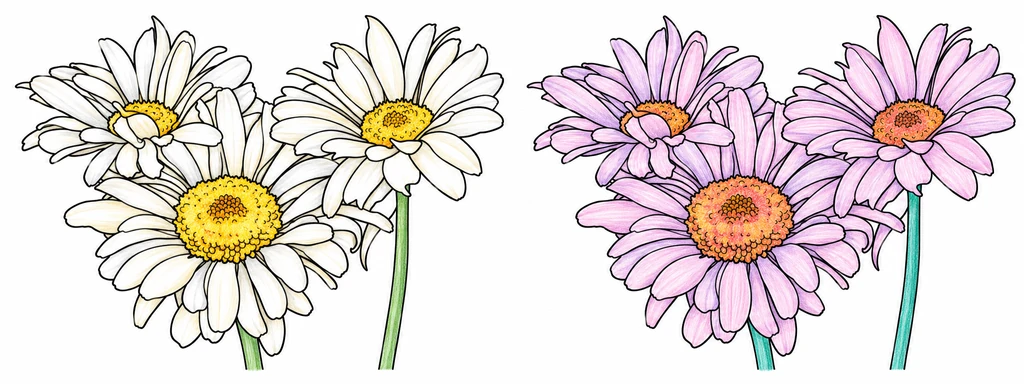
Use this paper activity illustration as a guide, then assemble your own printed pictures.
Gather what you need
- One flower photo with clear petals and a visible center
- One selected coloring result, printed twice
- Crayons or pencils, the original photo and a sheet for short notes
Choose a drawing that fits this activity
Choose one bloom with open petal shapes. Start AI with Medium detail and reduce it if texture crowds the petals; a clear Free result can also work. Select one drawing and print it twice so the color comparison uses matching shapes.
FreeConvert on your device, with no account or credits.
AIChoose drawing settings, sign in and submit with the displayed credits.
Compare two palettes on the same flower
Choose a bloom with shapes to compare
Pick a photo where petals and the center are easy to see. Use the flower tool, then inspect the outline against the original. Avoid a page whose crowded lines hide the areas you want to color.
Print two matching outlines
Choose the same paper size and print scale for both copies. Mark one 'Observed' and the other 'Invented' by hand. Keep the original photo nearby, so both pages have a clear purpose.
Follow the photograph on the first copy
Look at the petals, center and any leaves separately. Choose the closest colors available in your materials; exact color matching is unnecessary. Note a visible change in shade if it is important to you.
Try a different palette on the second copy
Change one or more colors while keeping the same outline. You might use a limited set or put a contrasting color in the center. Describe your choice rather than treating it as a claim about the real flower.
Compare what the colors changed
Place both pages beside the photo and discuss which areas stand out. Add one short note about the observed palette and one about the invented version.
When the drawing has changed the petals
Use the original for petal counts or botanical observations. For this color experiment, choose an outline with usable open areas, or try another result if the change distracts you.
Help with paper size and marginsA ready-to-print page can work alongside your photo
These free coloring collections offer another picture for the activity, or a starting point when you do not want to use a photo.
Questions about Flower photo color study
Two copies of one flower outline, showing an observed palette and an invented one.
Do I need two different generated images?
No. The activity deliberately uses two printed copies of the same result.
Must the first copy match the photo exactly?
Use the closest colors you have and explain differences. The task is careful looking, not exact color calibration.
Can this identify the flower?
No. The activity compares colors; plant identification is separate.
Which coloring materials should I start with?
Use materials you already have and test them on a spare print. Pencils can reach smaller petal spaces; broad crayons are easier with larger open shapes. Use the same materials on both copies if you want a more direct comparison.
Choose your picture and make it on paper
Two copies of one flower outline, showing an observed palette and an invented one.